A van Gogh sky.
Hope you have a good weekend everybody!
Your Custom Text Here

Photo credit: Jim Callner
A van Gogh sky.
Hope you have a good weekend everybody!

Dear Attorney General Jeff Sessions,
I am writing in response to the NBC article reporting you stated that communities need an "involuntary commitment" option for the mentally ill. (https://www.nbcnews.com/politics/justice-department/sessions-says-communities-need-involuntary-commitment-option-mentally-ill-n856961
As the mother of a 30-year-old son who has suffered with a serious brain disease most of his life, as a state and national advocate for mental healthcare reform, and as a native Alabamian, I couldn’t agree with you more. But what about providing funds for humane medical options for the “right to treatment” instead of the “right to die?"
In most states, including Alabama, for a person to be admitted to a hospital involuntarily, a judge must be persuaded that the patient is a threat to self or others. In other words, involuntary commitment requires a person to become dangerous in order to access even a 72-hour hold. The #1 roadblock to utilizing “involuntary commitment laws” is that no psychiatric hospital beds are available. I’m sure you're well aware that more people with serious brain diseases end up in Alabama’s jails than in Alabama's hospital beds.
Our state’s law enforcement officers have become our de facto medical providers but this is beyond their scope of practice. When my son was a younger, I kept the phone numbers of many medical providers to help us keep my son safe, and to help him remain in treatment so he could be successful at work, in school, and in the community. But sadly, once he became an adult and had rights to refuse treatment, my phone book filled up with the numbers of law enforcement, attorneys, and judges. Why must we criminalize people with brain diseases in order for them to access medical care?
Dorothea Dix would turn over in her grave if she could see how far we’ve come as a nation sending people to the moon and beyond, and how far we've fallen in terms of how we treat the sickest individuals among us. Too often the tragedies we read about are of people who cried out for help. However, the hands of families, law enforcement, and community mental health providers are tied until we change the "commitment laws criteria" and open more inpatient beds — not more jails or prisons. Parents like me are counting on you to turn the tide and stop the madness of the broken mental health system.
Please consider solutions stated by renowned author and mental health advocate DJ Jaffe: 1) Eliminate a Medicaid rule (IMD Exclusion) that prohibits states from using Medicaid funds for seriously mentally ill adults who need long-term hospitalization. 2) End the practice of requiring someone to become dangerous before their families can intervene to help them. We could do that by supplementing the standard — "danger to self or others" — by which we presently commit mentally ill people to health facilities to also include “need for treatment,” “grave disability” and “lack of capacity.” https://nypost.com/2018/03/17/facing-the-facts-about-violence-and-the-mentally-ill/
Thank you in advance for enforcing more humane options for those with brain diseases who deserve treatment not punishment. This is your job. My son and I are the people you work for.
Sincerely,
GG Burns
Mother and Brain Health Advocate for Reform
Some children grow up to fight wars on foreign soil for causes not their own.
Some children must fight addiction, sometimes their own or sometimes their parents.
Some children are born into poverty and fight hunger, need, and homelessness.
Some children are the victims of bullies and fight just to be treated as a person.
Some children fight physical illnesses and disabilities.
Then, some children fight unseen forces that affect every aspect of who they are and who they can be; what they can achieve and where they can fit in; who they can love and who will love them back. This dreaded unseen force, also known as serious mental Illness, consumes them, their life, their future, their family, and their ability — and the ability of those who love them — to live what others take for granted as a normal life.

Photo credit: Bahman Farzad/flickr

Photo credit: Jim Callner
California sunset.
Hope you have a good weekend everybody!
March 9, 2018
Dede,
Thanks for writing me back. Thank you for all that you do for mental health. Good luck with your book. Sorry to hear what happened to your son. I'm sure he would be proud of your effort to help families who struggle with mental illness.
i don't want to die. But exercising has been difficult. I haven't wanted to exercise. I'm depressed. I'm happy you can find some peace by driving in the country and looking at nature. Thank you for reminding me to take it one day at a time. I tend to forget that.
I'm struggling to stay positive. I feel like all the fight in me has been taken out. I pray for your book to be a success. I pray for your heart. This isolation has made me afraid of life. I'm afraid I'm too far gone. If you want you can use my letters on your blog. Hopefully, the next time I write it will be more positive.
Sincerely, Travis
California Men's Colony State Prison
P.O. Box 8101
San Luis Obispos, CA 93409-8101
Travis Christian
CDCR#: bb8099
Cell #: B-1
NOTE: Travis's mom reports that he's been moved out of solitary, temporarily, due to his deteriorating health. He's still in isolation, however, in a critical care bed. She fears for his life.
See related posts:
Feb 3, 2018: Letters from Solitary Confinement
Feb 6, 2018: So Where Do I Go From Here?
Feb 10, 2018: My Letter to A Young Man in Solitary Confinement
Feb 27, 2018: Letter from Travis in Solitary Confinement

Travis
I spent the day with a client who has schizophrenia and is medicated only because it was mandated he be medicated when he was in prison. We're jumping through hoops to keep him on his meds after his release from prison.
In our initial phone call with Medicare, we were on hold for an hour. I wanted to inquire why my client cannot pick up the medication that is waiting for him at the pharmacy? I was told my client must first go to the Social Security office to complete his reinstatement of Medicare. Really? A client with paranoid schizophrenia must go wait in a government building with tons of strangers?
As his therapist, I took him to the Social Security office and waited for 3 hours to be told he needs to have a stack of papers filled out and his legal guardian needs to sign something (you know those attorneys that see their client maybe once every two years). Meanwhile, my client was becoming more symptomatic. With his eyes darting around the room, he became increasingly restless in his chair.
I've established trust with this client, so I am usually able to de-escalate situations for him. But I am furious that finally, when he understands that he needs meds, he has to go through so much red tape to get them. After being released from prison and determined to be disabled, Medicare and Medicaid services should be ready for clients, not barriers for clients.
People with diagnoses of serious mental illness (SMI) should not have barriers to medications. Any gap in medications can lead them to self-medicate on substances like crack, meth, alcohol or heroin. I have clients on all of these substances, and crimes are often committed with the combination of SMI and substance abuse more often then not.
I am a therapist. I can't force my clients to medicate and I can't always make the medications available to them — although I've found myself to be a pretty good beggar for things like United Way funds to pay for meds. Meanwhile, our community mental health agency is underfunded. We have a whopping 13 beds on our crisis unit and the wait time for new patients to see the doctor is two months out.
As an assertive community treatment (ACT) therapist, my goal is to be part of a team that offers wrap around services to keep clients out of prison. Sometimes I find these clients during outreach (driving around the community). At this point, however, we still need the police and court involvement (thank goodness for mental health court which is my Thursday job) to bring them back into treatment.
If someone knows how we can mandate medication, without the process being abused, before a crime is committed, please speak up. I believe, once a crime has been committed and clients have been diagnosed with SMI, they should be mandated to take meds. And, for god sakes, the meds should be paid for — happily — by our government.

Melinda

Photo credit: Marisa Farnsworth
Winter beach.
Hope you have a good weekend everybody!

Image credit: Jonathan Faz/flickr
Today, my thirteen-year-old daughter, Emma (not her real name), was diagnosed officially with reactive attachment disorder (RAD). Prior diagnoses are PTSD, ADHD, ODD, OCD, personality disorder, and anxiety. In November, she was hospitalized for saying she was going to kill herself. She had to stay in the facility for two weeks until she was “self-aware."
I am my daughter's fourth mom. Her biological mom and dad had drug issues and her mom had schizophrenia. She and her siblings were taken away when she was a baby. Her foster mom sat her in a high chair all day in front of the TV. She was removed from that foster home because of abuse. My husband and his ex-wife adopted Emma when she was three. My husband's ex is an alcoholic and didn't nurture her adopted daughter. She was verbally abusive and no longer has a relationship with her. I have been in her life for three years. I love her and treat her as if I gave birth to her. Life with her has been challenging and sometimes exhausting.
Emma pushes me and her sisters away and has no close friends. She’s never invited anyone to our house. She's manipulative and a pathological liar. She digs her heals in big time when she’s caught. She has a nasty attitude when she's moody. I swear she looks possessed at times.
The last couple weeks seemed like she was finally letting her guard down with me. We were doing great. Then, just like every time she starts improving, she sabotages herself. Her teachers told us her foul language is a problem. During her IEP meeting, we agreed that, if she were to swear in front of a teacher and cuss again, she would wear a uniform to school. Her school doesn’t wear uniforms. This is the only thing that works with her. So a week later she told the teaching assistant to F-off. She was suspended from school.
My husband told Emma she'd be wearing her uniform when she returned to school. She said, "I don't care." Because it’s cold, we adjusted her uniform to beige pants, a polo shirt, and a cardigan. It was not the usual skirt, so it was no big deal for her. When my husband said he was buying her a plaid skirt, she broke down crying. She said, "I'm sorry." We didn't give in.
The following day our daughter went to school and confided in the lunch lady. She said my husband is abusive, she’s afraid to go home, and that she plans to run away. Needless to say, we got a phone call from the school. I explained she is being manipulative and my husband is the nicest man alive. Because of their history with her, I think they believed us. It’s been a week and Child Protective Service (CPS) hasn’t shown up. Yet.
Saturday, we had a family meeting to inform the kids that one of them put our family in danger of being split up, that CPS could come. We wanted Emma to see that her actions affect everyone around her. Five of our six kids cried. She just zoned out and played with her lips. My husband cried as he told her he’s never felt so stabbed in the back by someone he loves. Her real brother asked her how she could be so selfish. He remembers foster care and it was horrible. He was beaten with a belt and locked in his room all day. He said, "Our foster parents didn’t love us but they (my husband and I) love us." She had no reaction. We chose to ignore her and not let her consume all our energy.
Monday, Emma tried to manipulate her teacher into calling us to talk us out of making her wear a uniform. Her teacher knew what she was doing and instead informed me of the conversation. That night Emma came back from confirmation class at church and told me she doesn’t believe in God. Every Sunday she turns the switch on when we get to church. She looks like the most pissed off person with an attitude. She has a victim mentality and cannot see blessings in front of her.
Last night, at dinner, Emma was awful. She refused to answer my husband when he spoke to her. She rolled her eyes a lot and ignored him. My husband asked her, "Why are you treating me like this?" She said, "Because you can’t do anything. You made a promise to the judge you’ll take care of me forever when you adopted me." He asked her, "Do you want to be here?" She said, "No, but I have nowhere else to go."
We live comfortably and Emma has no idea what hard is. When she’s not in one of her pissy moods, she can light up a room, but she's an attention hog and takes over every situation.
Today, when we went to her therapist's office, Emma showed everyone her true colors. She refused to acknowledge her therapist at all so her therapist asked me to fill her in. I told her everything Emma had done including trying to get my husband in trouble. My daughter was so annoyed, she sat as close to the wall as she possibly could. Her therapist decided to call her superior in. The new therapist said, "I'm sorry, but we shouldn't be talking in front of your daughter." She asked to speak to Emma alone in another room. As she left the room, Emma looked back at me and smiled as if she'd won. The counselor said, "Don't worry, my superior will see right through her. She's told me that your daughter has RAD and needs intensive counseling. I'm not sure we can do that here."
When the senior therapist came back into the room, I said, "I can't do this anymore. Emma consumes our entire family. We have six kids and five of them aren't getting the attention they deserve. I have no idea what's going on in their lives and I feel like such a horrible parent. My second wedding anniversary is coming up and I totally didn't realize it." I started crying. Somebody finally believed me. The senior therapist is going to get Emma intensive counseling and set us up with in-home family counseling. A peer group will come and take Emma out of the house for three hours a week to give us a break.
After the appointment, Emma was in her total bitch mode. I dropped her off at school and the rest of the day I've been emotionally drained. I've cried like I lost somebody. I have little hope for Emma's future. I don't know what to do.
Click on link: Information about RAD (Mayo Clinic)

Photo Credit: Paula Lozar
Holding wings.
Hope you have a good weekend everybody!
The world has lost a Mother of Perpetual Determination (MOPED), a fierce advocate for people with serious mental illness (SMI), and a mother who lost her son, Farron, through neglect in prison. SMI is often criminalized and, in 2007, Farron was suffering SMI which resulted in his tragic, avoidable death.
As Farron's mom above all else, Mary's love and pain were channelled into successfully advocating for SMI in Alabama and nationally. Mary was truly one of the best. My experiences with Mary came well after I had witnessed her greatness and had grown a deep respect for her work.
One day, out of the blue, Mary sent me a message. She said she saw a lot of herself in me, perhaps with more grace, as she witnessed me taking on the anti-psychiatry people. Huge compliments came from this great woman and she grew my confidence enough for me to join in the national fight for decriminalization of and better treatment for people with SMI.
I will forever work in honor of you, Mary. I, as you, will never give up, will never give in, and will always use my mama emotions to motivate my advocacy. You are now reunited with Farron which is all that eases my pain. I miss you beautiful warrior mama. Rest easy now.
Mary Barksdale's family has requested donations be made to Parents for Care, in memory of this beautiful spirit.
See Mary Barksdale's posts on this blog:
Losing Farron - October 26, 2016
My Holiday Story - November 22, 2017
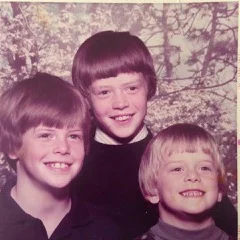
Mary's boys: Will, Farron and Phillip