THE BEST TEACHER I'VE EVER HAD by Deborah Fabos

My son, James, is 34. I'm so proud of the man he's become, and grateful to everyone who's helped him get where he is today. Mostly though, I'm grateful for him.

You see, although I'd take away his illness if I could, his journey's made me a better person. Although I'd eliminate all the pain he's walked through, his pain's enabled me to be more compassionate. Although I'd give him back the life he knew before his symptoms took it all away, I'm grateful each day that he is alive and able to give and receive love.

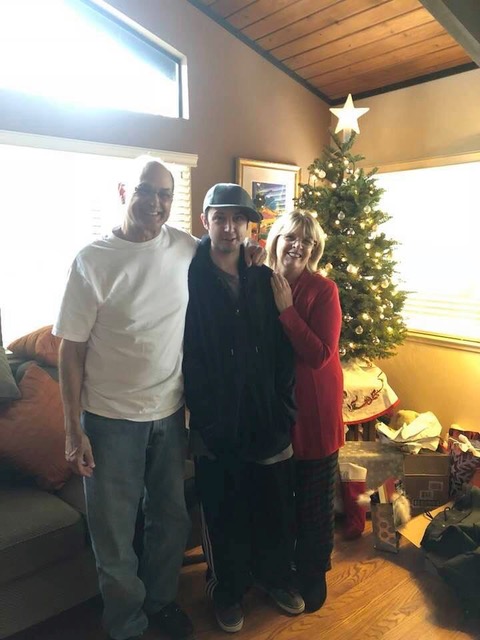
This picture was taken in January 2017. James looks the same except that he's thinner now. There were so many times along the way that I never, in my wildest dreams, thought he could enjoy such a wonderful quality of life. Don't get me wrong, he can't hold a full time job and will never be totally independent, but he's accomplished so much more than we dared to hope for.

James

James

A wise man once told me that what I needed to do was give my son something he didn't want to loose. This was what I built everything on. It's a solid foundation. Of course, as you well know, doing it takes a village! 

Just a little back story because I understand how hopeless and overwhelming caregiving for our loved ones can be — the pain, the endless stress, the blocked paths to treatment, the grief, and the feeling of isolation.  For my son, his journey started before his birth, really. I was high risk due to having placenta previa and he was in fetal distress during labor. They couldn't find a vein for an IV so I could have a C-section so other methods had to be used. James was blue from a knot in the umbilical cord that was wrapped around his neck.

When James was in second grade, he was diagnosed with ADHD and we started behavior modifications along with medication. He continued with behavior modifications until he became so ill that they didn't work well.

James was always a gifted athlete. In his freshman year of high school, his coaches told him to look for college scholarships in basketball, baseball, and football. But, by age 15, his symptoms were  severe and he was put in a locked down facility out of state because he was still a minor. I appealed to the court to release him into my care so I could get him treatment. He needed treatment, not punishment, and it's in the right treatment that we found our hope. That's why I do what I'm able to help more find their treatment in time. 

My son's been and continues to be one of my greatest blessings and the best teacher I've ever had. I'm honored to know him and to have the privilege of being his mom.  At long last, he's at peace with his life. He's on the other side of his horrific journey. His kindness, gentleness, and his never giving up have lead him here. He's able to enjoy the present and let go of what once was. 

OUR STORIES CAN RESONATE IN WAYS BEYOND OUR COMPREHENSION by Dede Ranahan

At year's end, I'm so proud of this blog and the storytellers who've made it happen: Marie Abbott, Margie Altman, Gilbert Anderson, Jr., Janet Wood Asbridge, David Bain, Mary Barksdale, Tama IsesaJah Bell, Joyce Berryman, Ronni Blumenthal, Judy Waldo Bracken, Kendra Burgos, Crystal Burks, GG Burns, Robin Burton, James Callner, Sylvia Charters, Laurie Lethbridge Christmas, Elizabeth Courtois, Deborah DeLash, Sonia Fletcher Dinger, May Enos, Deborah Fabos, Laural Fawcett, Anne Schmidt Francisco, Heidi Franke, Mike Gaeta, Patricia Gager, Sheila Ganz, Deborah Geesling, Val Greenoak, Jeanne Gore, Donna Hairston, Janet Hayes, Gloria Hill, Sherry Hunter, Dj Jaffe, Joe IV, Amy Kerr, Kevin, Nikki Landis, Ray Maternick, Maggie McGurk, Lynn Nanos LICSW, Linda Olivia, Teresa Pasquini, Laura Pogliano, Donia Que, Diane Rainbowitz, Patrick Ranahan, Ryan Reyes, Karen Riches, Frank Robbins, Kate Schultz, Joann Strunk, Andrea Turner, Sandy Turner, Cheri VanSant, Laurie Lamsus Vogel, William Vogel, Lynne Warberg, Christi Weeks, Kim West, Craig Willers, Mindy Willers, and Maggie Willis.

Storytelling is ancient. Over time, storytellers, who are good at chronicling the important events of their tribes, come to reach positions of respect and power within their communities. Storytelling is one of our most important traditions because stories instruct and inspire. Stories help us feel what others feel when we haven't experienced what they've experienced. Stories help others feel what we feel when they haven't experienced what we've experienced. Stories help all of us feel not so alone.

Sometimes it's not easy being storytellers. We don't know if anyone is reading our stories. It can seem like we're writing our stories in sand. But look at the photo below. The "story in sand" represents someone's anonymous time and effort. At water's edge, this undertaking will be washed away. Before it vanishes, however, it's been captured by at least one photographer and I'm posting the image here and passing it on. The artist has no idea of the reach and impact of his/her/their soulful expression. Likewise, our stories can resonate in ways beyond our comprehension.

I hope, in 2018, you'll continue to tell your stories. I hope, in 2018, your stories will include accounts of improvement in the lives of your loved ones and in mental illness care. Thank you so much for writing for and reading this blog. And, if you're inclined, please share Sooner Than Tomorrow with your families and friends.

Photo credit: Marisa FarnsworthMarisa is my daughter. She's taken most of the photographs I've used for HAPPY PICS.Thank you, Marisa. 

Photo credit: Marisa Farnsworth
Marisa is my daughter. She's taken most of the photographs I've used for HAPPY PICS.
Thank you, Marisa. 

DANNY LOVE by Teresa Pasquini

#ShatteringSilence4SMI- Sharing a final reflection of our family’s 2017 Christmas Miracle. I think it is clear that Danny enjoyed being home with family and friends and we enjoyed having him home. 

I was able to sit alone with him on Christmas morning and show him his Facebook fan club. He had never seen a Facebook page. He loved the picture of me holding the “My Danny Matters” sign. He loved reading the comments from old friends and new friends. He loves knowing that people care. 

He was sad to pack up and go back to California Psychiatric Transitions (CPT)* but he knows that he has to complete the program before he can step down to community placement. We made the two-hour drive back feeling love and gratitude for the time we had together while holding onto big hopes and dreams for 2018.

We arrived back at CPT to see families like ours visiting their loved ones onsite. We were welcomed back with such kindness by staff and observed how they helped Danny transition back behind the locked doors. A final big hug for mom and dad and he was gone from sight.

I drove home while my exhausted husband slept feeling at peace but knowing that the road ahead for our Danny will be bumpy. I will be working on smoothing out Danny’s future journey and hopefully, we will find the right path for him and all families like ours. I will also never forget those who have no family to pick them up and bring them home to sleep in their own bed. 

I will never give up the fight for #OneCare #Everywhere because I love someone with a serious mental illness. 

Thank you all so much for the #DannyLove ❤️


*CPT is a mental health rehabilitation center in Delhi, California, Merced County (cptmhrc.com). Teresa says, "We need a CPT in every county in the state and yet our Governor and legislature cut the budget for these facilities in the 2017 budget. These are also the facilities that the Feds refuse to fund because of the Medicaid Institutions for Mental Disease (IMD) Exclusion.** Discrimination!"

**The Medicaid Institutions for Mental Diseases (IMD) exclusion prohibits the use of federal Medicaid financing for care provided to most patients in mental health and substance use disorder residential treatment facilities larger than 16 beds. This limits the number of beds available for the those with serious mental illness. For an overview go to lac.org


Danny with his Mom & Dad Christmas 2017

Danny with his Mom & Dad Christmas 2017

From the oldest

JUDGE NOT by Christi Anne

About five years ago I captured this photo of my son Ryan walking in downtown Phoenix. If you look closely you will see a homeless man sleeping on the ground by a trash can. 

24231809_10210865461695067_2479570311278099744_n.jpg

I couldn't help but notice the similarity in that man's clothing and my son's.  I thought "There but for the grace of God go I."  Followed by the thought, "But where is God's grace for that man on the ground?" I was troubled by that thought until I found a poem titled "Judge Not."

Judge not; the working of his brain
   And of his heart thous canst not see;
What looks to thy dim eyes a stain,
   in God's pure light may only be
A scar, brought from some well-won field,
Where thou wouldst only faint and yield.

The look, the air, that frets thy sight,
    May be a token that below
The soul has closed in deadly fight
   With some internal fiery foe,
Whose glance would scorch thy smiling grace
And cast thee shuddering on thy face!

The fall thou darest to despise...
   May be the angel's slackened hand
Has suffered it, that he may rise
   And take a firmer, surer stand:
Or, trusting loss to earthly things,
May henceforth learn to use his wings.

And judge none lost, but wait and see
   With hopeful pity, not disdain;
The depth of the abyss may be
   The measure of the height of pain,
And love and glory that may raise
This soul to God in after days!

Adelaide Anne Procter 1825-1864

There was a period of time when my son was very ill and sometimes homeless, relying on the compassion and generosity of strangers, asking for change to buy himself something to eat or drink. Today my son is the healthiest he has been in over 10 years. He's able to go to work and earn a paycheck. 

I was worried about how he would use the money when he received his first paycheck. Yesterday I gave him $40 dollars to have in his new wallet. Today he had $7 dollars left. He spent his money buying treats and food for his friends in the group home. He remarked about how good it felt to be nice and do something nice for others. 

Tonight we celebrated his 31st birthday at a seafood restaurant. During dinner, Ryan told me that, earlier in the day, he'd given a man on the street a handful of change because he remembered, when he was in that man's shoes, asking others for change.

Once again,  I'm so grateful and amazed. It's by the grace of God, doctors, medication, and unconditional love that my son, who's suffered for so many years with severe mental illness, has come out the other side.

And yet he remembers, "There but for the Grace of God go I."

TOO MUCH PRIVACY by Lynn Nanos LICSW

Although the federal law to protect patients’ confidentiality, Health Insurance Portability and Accountability Act (HIPAA), can appear excessive when it interferes with providing ideal care to psychiatric patients in emergency services, it presents even more challenges in inpatient work. In emergency services, releases of confidentiality documents are unnecessary when involuntary holds are in place. No release of confidentiality document has to be signed by patients to talk with their legal guardians or physician invoked health care proxies. 

I’ve had the privilege of working in both inpatient and emergency psychiatry as a licensed independent clinical social worker. Inpatient cases typically last longer and involve more clinical exploration than emergency services cases. Inpatient units are designed to plan for discharges and aftercare much more than emergency services are. 

It can be nearly impossible to obtain reliable information from a patient who is so disorganized that he or she can barely form a sentence, is highly agitated, is not wanting to be there, and is paranoid. As a social worker on inpatient, I obtained background information from family members or friends of the patients, updated them on progress, and gauged readiness for discharge based on their impression of patients’ progress. Some patients refused to allow me to provide information to anyone on the outside who cared for them.

I knew family members were concerned about patients on my caseload because of the desperation I sensed in their voices and frequency of calls. A young woman in her early twenties was admitted to inpatient because the police found her attempting to stop traffic on the highway. She couldn’t logically explain the reason for doing this after she adamantly denied that she was suicidal. She believed that her admission to the unit was all a misunderstanding and that if only I called the police to clear it up, she could be released. She wasn’t in any ongoing outpatient treatment because she didn’t believe that she was ill. 

Still, on an involuntary hold, the patient refused to sign the documentation that would have rendered her voluntarily there. She also refused to tell us the name and phone number of any family or friend. Apparently no next of kin knew that she was there and there was no family member listed in her chart. Despite her thought process and behaviors being disorganized, the psychiatrist didn’t believe this patient qualified for an extended involuntary commitment and discharged her accordingly.  

Just hours later, this patient’s mother called the unit. The call was transferred to me because I was the social worker and expected to manage most family interactions. After telling me that she’d been calling all local hospitals and police stations, the mother asked me if her daughter was there. During the uncomfortable silence as I struggled to find something to say, she began to cry and said that she'd thought about calling morgues, too. 

I felt horrible. Who was responsible for leaving this mother sick with desperation? Who allowed the psychotic patient to fend for herself without any care? Who dropped the ball? The police officer who authorized the involuntary hold either didn’t care enough to find a next of kin to inform or found it impossible to do so. The hospital emergency department staff couldn’t locate a family member. The patient probably didn’t give them any clue about this. 

Perhaps, if the psychiatrist had asked more questions of the patient and looked more closely at her, she would have understood that she wasn’t ready to be safely discharged. She’d probably have remained on the inpatient unit if her mother had been able to share her concerns early on. But now, there was nothing anyone could do to make things better.  

Aside from speaking in “code” to families, which I've done, there’s not much any of us can do besides advocate and put pressure on the government to make changes. In my forthcoming book, Breakdown: A Clinician’s Experience in a Broken System of Emergency Psychiatry, I offer a simple solution to alleviate HIPAA constraints.

Lynn Nanos

Lynn Nanos