A LETTER TO MOM AND DAD AND FAMILY by William Vogel

Laurie Lamsus Vogel writes: "I'm sharing a letter William gave us when we visited him last weekend. This is the hand writing of a 17 year old who has had to have an alpha smart machine (word processing keyboard) due to not being able to write. Whatever Red Rock Canyon is doing with this boy, it's working. "

William/Buddy is in a residential treatment program for serious mental illness.

William's letter to his family.

William's letter to his family.

See "A Letter to My Son" by Laurie Lamsus Vogel on this blog June 27, 2017


From the oldest

ENABLING VERSUS PROTECTING by Margie Altman

Why we need to know the critical difference between enabling and protecting.

Families and friends of the seriously mentally ill are often accused of enabling inappropriate, dysfunctional, and harmful behavior. This label is terribly destructive for those who work tirelessly to help their loved ones and friends. This accusation can and does lead to dismissing the observations and information that families and friends try to impart. When they are viewed as enabling, their views are seen as unimportant and valuable things are disregarded/dismissed.

Enabling, in its negative sense, is the facilitation of harmful, inappropriate behaviors in an active or passive manner. The "enabling" comes from a variety of sources — avoiding stigma and shame, fear of the loved one's reaction to confrontation, lack of education about how to cope with mental illness, and other factors.

Protecting, on the other hand, is a natural feature of human and animal behavior when an individual has become ill, weak, or confused. In the animal kingdom, when survival of the group is at stake, the group may leave the sick individual behind. Protection is the action/behavior of being alert to harmful obstacles in the path of the ill person, identifying dangerous situations and behaviors, and advocating when the individual faces social injustice.

Protection is a necessary part of life for family and friends of our loved ones who struggle with emotional challenges and serious mental illnesses. In this chaotic, unpredictable and stigmatizing world, protection is needed more than ever before.

Margie

Margie

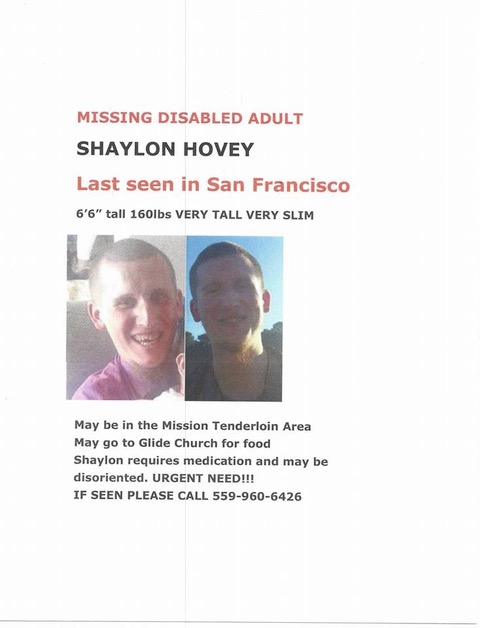
HAPPENING NOW: SHAYLON'S STILL MISSING by Laural Fawcett

I just spoke, by phone, with Laural who is Shaylon's mother. Despite her calls and pleas to various players in the mental health and criminal justice systems, nothing is happening. No one, it seems, will help her find her son.

I've forwarded my blog posts about Shaylon to the Mayor of San Francisco, to the Captain of the Tenderloin Police Station, and to the San Francisco Mental Health Board. No response.

There are hundreds, if not thousands, of Shaylons on the streets of San Francisco. Many have families desperate to find them. The bureaucracy doesn't care.

Shaylon on the street...

Shaylon on the street...

See other posts about Shaylon on June 20, 2017 and June 26, 2017.


INSANE CONSEQUENCES: LETTER TO THE SACRAMENTO BEE

June 25, 2017

Dear Editor,

Darrell Steinberg and Dr. Carter correctly note that 20% of the almost $2 billion raised by the Mental Health Services Act ($400 million) is already required to go to Prevention and Early Intervention (PEI) services. As Darrell Steinberg said when lobbying for that program, “We can’t prevent certain mental illnesses, such as schizophrenia and bipolar disorder, but we can prevent them from becoming severe and disabling.” That’s what PEI funds were supposed to do.

As the state auditor, two little Hoover Commission reports, the Associated Press and Mental Illness Policy Org have all revealed, that didn’t happen. Programs to improve grades, eliminate divorce, improve job prospects, reduce bullying, gain comfort with sexual identity, and teach art are all being wrapped by counties in a mental health narrative so PEI funds can be diverted to them. So rather than create yet another tax-payer fund “that gives counties financial incentive to infuse far more resources into early intervention for psychosis and serious mood disorders,” why don’t we first ensure that the original $400 million already allocated to that purpose achieves it?

DJ Jaffe

Click on this link to see Insane Consequences on Amazon:
Author, Insane Consequences: How the Mental Health Industry Fails the Mentally Ill

This well-researched and highly critical examination of the state of our mental health system by the industry's most relentless critic presents a new and controversial explanation as to why--in spite of spending $147 billion annually--140,000 seriously mentally ill are homeless, 390,000 are incarcerated, and even educated, tenacious, and caring people can't get treatment for their mentally ill loved ones.  
 

A LETTER TO MY SON by Laurie Lamsus Vogel

I finally got my parents' family therapy packet from my son's residential treatment facility. (Yep, we have homework and I still love this place.) My first assignment was his biography, then yesterday, I had to read him a letter I wrote about what his life might have been like if he didn't go into residential treatment. We've talked about this often because he's been gone 6 years. His entire adolescent years -- eleven to seventeen. Here's the letter I wrote to him. It wasn't in detail because I was at the ER with a possible broken hand when I wrote it. 

To My Dearest William,

I know you're tired of being in treatment and want to come home. We want you home, too. You are so close to being ready and we look forward to the day you come home for good. I want you to know that being in treatment has saved you from a terrible future. 

Before you went to residential, you had many unsafe behaviors which were putting you in danger. If you'd continued to run away, and had succeeded, you'd likely be living on the streets with no love or support. You wouldn't have food or water or a warm bed to sleep in. You wouldn't be getting the treatment and medication you need. The likelihood that you'd start self-medicating with alcohol and drugs is high. Then, the people you'd associate with could be bad people and either hurt you, or worse. The aggressive behavior would probably come back and you'd most likely hurt someone and possibly end up in jail. Most inmates are mentally ill and didn't get the treatment they needed. Most of them keep committing crimes and are in and out of jail. Also, if you were to hurt someone, I think it would make you sad because you have a good heart and don't like seeing people hurt. 

You have a bright future ahead and I know, when you graduate the program and come home, you'll be ready to be a productive member of society. I'm so proud of how far you've come and I love you more than words can say. 

Love, Mom

William

William

HAPPENING NOW: UPDATE ON SHAYLON By Laural Fawcett

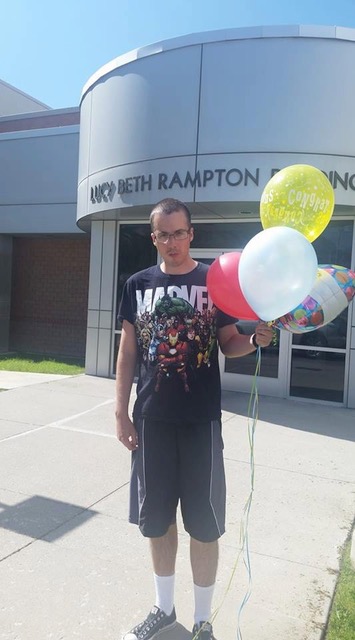
Here is my son wandering on the street in San Francisco followed by an old friend from junior high school who is trying to help me get law enforcement to arrive, and the mental health crisis team to get him to medical treatment.

They'll keep him for a brief time and then dump him on the street again before providing complete care. He has a medical condition and is in complete delusional psychosis. I'm trying to get him the treatment he deserves.

People look at the homeless as if this is normal or a lifestyle choice. It's time to wake up and stop believing the lies that are causing neglect and death of disabled persons and the diversion of funds. The mental health care system is failing to provide services that it's funded to provide. Instead, It burdens law enforcement, first responder, and the criminal justice system with the costs. It uses excuses and hides behind HIPPA and "civil rights" and leaves many to suffer on the streets and in jail.

My son has a right to treatment. I'll continue to shout to the rafters until everyone stops turning a blind eye. The homeless population is primarily made up of disabled persons like my son. Many have families desperate to care for them. Those who don't have family support are doomed in this system. We treat dogs better.

Shaylon on the street

Shaylon on the street

From the oldest

HEART TO HEART by Nikki Landis

It seems to hit me in waves that my life will never be as I imagined. That this is my reality. That so many things I dreamed of will never happen.

I know I'm grieving but does it ever get better? Have any of you settled in to your new reality and have the waves of sorrow passed?

I know I have so much to be thankful for, and I am. My family's been blessed beyond measure in so many ways. I go day to day relatively happy. And then it will hit again and I just want to cry. I don't always get to because there's a little face that needs to be kissed or a little behind that needs to be wiped and I don't want them to see me so sad. But sometimes I just need to cry.

I am such a fighter and that's not always a good thing. I've accomplished so many things that were supposedly impossible, and because that's my nature it makes this harder. I seem to always be looking for ways to figure everything out so we can have the life I envisioned, even when it's not something I should be fighting for anymore. 

I am fighting bitterness. I want to stay thankful and happy and not get ripped up inside by things I should let go. 

Has anyone else beat this? How do you let go of dreams without hating the person with serious mental illness who has stopped those dreams? Or without hating the system that makes it so hard to get better and live life again?

Nikki and her husband, Kevin, who has a serious mental illness

Nikki and her husband, Kevin, who has a serious mental illness

WELCOME HOME MITCHEL! by Sherry Hunter

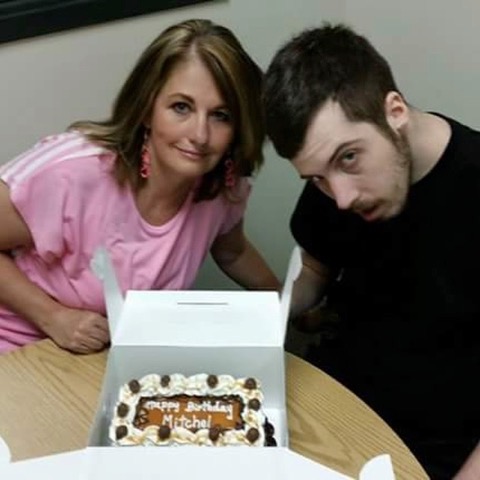
June 20, 2017 - We waited five long years for this day! Welcome home Mitchel! We love you. Never give up hope, no matter what.  

June 1, 2015 - Sherry and Mitchel 

June 1, 2015 - Sherry and Mitchel 

See these other posts by Sherry Hunter on this blog:
Acceptance - October 19, 2016
Anyone Want to Tell Me Why? - November 30, 2016
My son's Life - A Video - March 28, 2017

From the oldest