MY FAVORITE BOOKS by Dede Ranahan

Off topic for book lovers out there.  Here's some favorite books I'm reading and rereading. Feel free to add your favorites to the list. Click on comments below.

BOOKS I'VE READ RECENTLY
NONFICTION
Books on Mental Health/Illness

The Price of Silence - A Mom's Perspective on Mental Illness by Liza Long
No One Cares About Crazy People - The chaos and heartbreak of mental health in America by Ron Powers
Insane Consequences - How the Mental Health Industry Fails the Mentally Ill  by DJ Jaffe
These three books should be a set on every bookshelf.

Other Nonfiction Topics
Lassoing the Sun - A Year in America's National Parks by Mark Woods
Tribes - We Need You to Lead Us by Seth Godin
Armchair travel and inspiration to lead.

PICTURE BOOK FOR CHILDREN BUT EVEN MORE FOR ADULTS :-)
What Do You Do With An Idea? Written by Kobi Yamada and Illustrated by Mae Besom
I keep this book on a bookshelf next to my bed. It's the first thing I see when I wake up.

FICTION
A Man Called Ove
My Grandmother Asked Me to Tell You She's Sorry
Britt-Marie Was Here
All by Fredrik Backman - my new favorite fiction writer.

BOOKS I'M REREADING
Upstream - Selected Essays by Mary Oliver
Always a Reckoning and Other Poems by Jimmy Carter
Kitchen Table Wisdom - Stories That Heal by Rachel Naomi Remen, M.D.
The Art Of Listening in a Healing Way by James E. Miller
The Artful Edit - On the Practice of Editing Yourself  by Susan Bell
How the Light Gets In - Writing as a Spiritual Practice by Pat Schneider

BOOKS ON MY TO-READ LIST
It's a Matter of Trust - How I Got Better from OCD with Compassion, Help, and Hope by James Callner
The Other Side of History: Daily Life in the Ancient World by Robert Garland (A Great Courses book and CD)
Hillbilly Elegy: A Memoir of a Family and Culture in Crisis by J.D. Vance
Between the World and Me by Ta-Nehisi Coates
Beartown: A Novel by Fredrik Backman

AND LAST BUT NOT LEAST
On June 15, 2017, I'm going to begin blogging my book Sooner Than Tomorrow - A Mother's Diary.
It's my account about aging and family and ordinary life in the deep, dark past of 2013-2014. Without knowing it, as I wrote, I captured the last year of my son's life.

I hope you'll read along. Click on Blog: My Diary. Enter your email address to subscribe. You'll receive my book in your email inbox every other week. It's my gift to those of you who might catch a resonating echo while wandering in my woods.

HAPPY READING EVERYBODY!

HELPING FOLKS UNDERSTAND by Mindy Willers

Aloha everyone. I'm Craig Willers' wife.

See Craig's posts on this blog:
Hope is Critical - Nov 2, 2016
We are Sick, Not Evil - Feb 23, 2017

My heart breaks for all of you out there struggling. I feel like somehow I dodged a bullet. I met Craig three years after he spent six weeks in a mental hospital getting treatment for schizophrenia. One of the first things he told me was that he had schizophrenia. He seemed "normal". My mom was a nurse and didn't seem to be too concerned when sharing the information with her. I decided to go to the library and read up on it.

Fortunately, for both of us, he realized how important it is for him to take his medication. It made him feel lousy, but it was helping. He was working part-time and it was his boss who noticed something was wrong, encouraged him to get help and come back to work. I wish we knew where he was. We'd so like to thank him.

We married three years later in 1992. This year we will celebrate 25 years of marriage. We've only had one bad experience. Around 2006-2007 or so, while I was in nursing school, he couldn't reach his psych for a refill on meds, so we ended up in the ER. I never really liked her — she was a bit of a flake. We decided to find a new doctor. Big mistake. He couldn't believe Craig was so high functioning. He took him off his medications and started trying other ones. Eventually, Craig got to a point where he was not doing well. We decided to leave that doctor and go to a different one.

We got him back on his original medication — stelazine — which is a 1st generation antipsychotic that hardly anyone uses anymore due to the tardive dyskinesia (a neurological disorder characterized by involuntary movements of the face and jaw) side effect. He eventually got better, but never truly returned to his baseline before all this happened.

Craig continues to work full-time at the same job — he's been there over 30 years. I'm so proud of him. He's come a long way and it hasn't been easy. But it's been nowhere near as hard as some of the stories I've read here. I will continue to pray for all of you and hope we can offer a glimmer of hope.

Feel free to share Craig's story with your family members who are suffering with mental illness. It's so important to continue on the medications — if you can find medication that truly works. One of the difficulties with psych meds is it affects so many areas of the brain. They're all "dirty" drugs. He tried all the new strains and none of them worked. He had to go back to a first generation drug to get effective relief — and even then he's not 100% relieved. He describes it sometimes as like taking cold medicine. It helps take the edge off a little.

We decided not to have kids as my mother suffered from depression and attempted suicide a couple times. We knew there was a chance our child could be susceptible to experiencing something. 

We've been open in sharing our experience with others and hope it may help folks here. It hasn't always been easy, but I've always looked at our situation as I could have ended up with someone who was an alcoholic or abusive. Instead, I have someone who struggles with a mental illness. He knows it and he deals with it head-on. We don't know why he has it, but he does and we try to remove the stigma associated with it. I think because it deals with our brains and our reasoning, it's so much harder for people to understand. But we're working towards helping folks understand. 

Thank you for letting me share a little bit.

Craig and Mindy August 29, 1992

Craig and Mindy August 29, 1992

WHAT AN EFFING NIGHTMARE by Laurie Lethbridge Christmas

My son was in a locked ward psych unit involuntarily because he was a danger to himself (having schizophrenia and being off meds for eight months). He was psychotic and was losing weight because he'd not been cooking and eating. He didn't understand why he was there. He kept insisting that no one had the right to hospitalize him against his will. He asked to see a mental hygiene lawyer and, when she refused to get him out of the psych unit, he punched her.

My son was arrested and removed from the psych ward and taken to jail. He was charged with misdemeanor assault and sat in jail for a month. He was on no meds while in the hospital or the jail. I wrote a letter to the judge asking that he be re-hospitalized and he was then sent to an upstate hospital which was really a prison. He was in a section for pretrial detainees and his rights were more restricted than they were in the county jail. He sat there for eight months before they finally took him to the local mental health court down the street where an involuntary medication order was finally granted. All in all, he was 18 months without meds. Then, to add insult to injury, the charges against him for punching the attorney were upped to felony assault.  Why would the state charge a psychotic ill person with assault while in a locked psych ward? And why would a  lawyer, who is supposed to be an advocate, push the DA to raise the charges to a felony? And why did they let him sit so long without meds?  What an effing nightmare!

My son took his meds and was stable for 10 years before all hell broke loose. When it did, I started calling everyone I could find related to his issues — doctors, lawyers, and advocacy groups. Even NAMI (no help there). I was on the phone almost daily for a year. No one would help. I have a stack 5 inches thick of everyone I called. Then I had to stop for a minute. I was burned out. I even started a Facebook page for parents to no avail. This shit started in October 2012 and was not somewhat resolved until July 2014.

I still can't get over that my son sat in a psychiatric hospital for eight months without meds. My rage is often right under the surface and I have to take a break once in a while to keep my wits. After 2014 it was still a mess and it got bad again in 2015 even though my son was switched to monthly shots of abilify. He became psychotic again. The fight to get his meds changed took another year and a half. My son is somewhat stable now, but the 18-month psychotic breaks twice, caused some brain damage.

Laurie and her son

Laurie and her son

BUY THIS BOOK - by Anne Schmidt Francisco

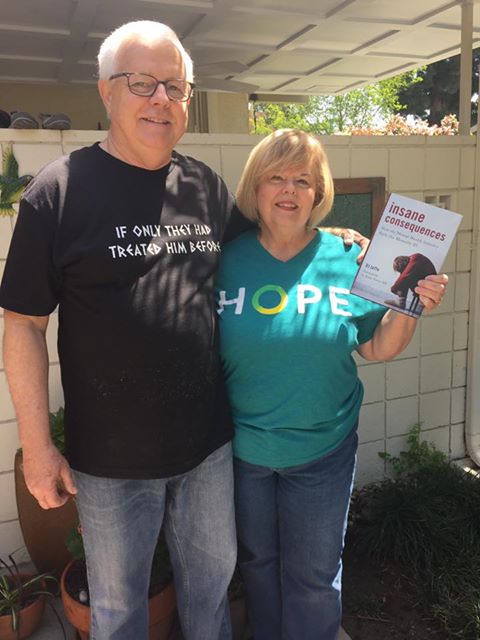
Look what Amazon brought us today. Call it insane, screwed-up, broken or whatever you want but the US mental health industry took our son, Josh, from us by denying him access to care when he desperately needed it. The industry is like a robber, stealing the lives of people and wrecking families across the country. Our friend and author, DJ Jaffe, has been fighting the inadequate system for 30 years. Please buy it and read it and send one to your US Representative. Take it to your local library and ask them to purchase a copy. Nothing will change until we all become educated and speak up. Thanks to all for your support. ❤️


Anne and ThurmanInsane Consequences - How the Mental Health Industry Fails the Mentally Ill by DJ Jaffe 

Anne and Thurman
Insane Consequences - How the Mental Health Industry Fails the Mentally Ill by DJ Jaffe


ASK AND HONOR by James Callner

In 1994, I lost my brother Dale to cancer. He was only 46 years old. Being five years younger, I always looked up to him for his great accomplishments and humor. He was a child psychologist, a wonderful father to his two children, and a compassionate, intelligent, and funny man with a dry wit.

 He was my brother. I miss him daily.

Dale’s cancer was terminal, and he was hanging on one day at a time. The OCD (Obsessive Compulsive Disorder) I was dealing with at the time made me extremely anxious about getting on a plane and flying from California to Seattle to visit him. I call this “the harming fear.” Some define it as a “hyper-responsibility obsession.” In my case, it was obsessive, magical thinking that I could harm my brother by my presence, or a simple touch, thinking that I possessed some kind of deadly, magical germs. This obsession overwhelmed me. And it restricted me from doing many things with my family. This was a defining moment.
.
My brother was dying. What could I do?

I was filled with guilt and self-judgment about whether I could visit him. It would mean taking the risk of getting on a plane, flying to Seattle, and pushing through my debilitating “harming obsession” that was now in full gear. I wept for not taking the risk to get on a plane. The
shame was intolerable. I did something that I was not raised to do as a child. At night, I got on my knees and prayed to God to help my brother. It was beyond painful for all of us in the family. And my anxiety and panic went through the roof because I was about to lose my brother. I was riddled
with guilt and didn’t know if I should or could push through my fears to see him.

Then, I had an idea that would last a lifetime. I thought, “Okay. I have OCD. My brother is in bad shape. I should go there and be with him and his wife. But I haven’t asked him if he wants me to come.”

The key word was “ask.” So I did. I called him on the phone. “Dale, do you want me to come out to Seattle to see you?”

He responded quietly and compassionately, “No, I really don’t have a need to see you.” Dale was not trying to take care of me because we didn’t have that kind of relationship. I didn’t take his response as an insult, for we had a phone relationship for many years. He was simply being honest. I heard it as, “I’m in bad shape and don’t want company right now, so let’s continue our
phone relationship. I’m good with that.” And that’s what we did, with our last conversation
ending with a mutual “I love you.”

Not long after those last words, my beeper went off one night. It was my mother’s number. I knew why she was calling. Dale had passed. My brother’s memory lives on. His spirit lives on. His
energy lives on. I know at a deeper level that our last words to each other, “I love you,” will live on too.

The lesson of asking what my brother wanted and needed, and honoring the answer, was yet another tool for my own recovery and a lesson for all of my relationships. How does that relate to OCD? Those of us dealing with OCD have to open our mouths and ask for what we need
and want in order to take care of ourselves. It’s empowering.

Excerpt from James Callner's book, It's a Matter of Trust - How I Got Better from OCD with Compassion, Help & Hope.