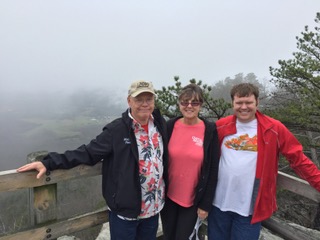
I was contacted recently by a local newspaper. Last week they published the article below (posted here with a couple of my corrections) along with a photo of me from the blog. NOTE: Instead of this article in a newspaper, I'd rather have my son back. Pat was a sensitive, kind, friendly man with an incisive sense of humor. He wanted, more than anything, not to have bipolar disorder and to live a long life. I miss him.
BLOGGING ABOUT MENTAL ILLNESS TO HELP FAMILIES
by Carol Feineman, Editor
Dede Ranahan wants other parents and their families dealing with mental illness to learn from her son’s tragic death three years ago. Her son, Pat, died in 2014 while in a hospital psychiatric ward, from either cardiac arrest or a seizure. Pat, who was 45, dealt with bipolar disorder since his childhood.
Ranahan, a Lincoln resident, started a blog in July in which she invites the public to add their stories about dealing with their loved one’s mental illnesses. The blog, “Sooner than tomorrow, A Safe Place to Talk About Mental Illness in Our Families,” can be found at soonerthantomorrow.com. It is also the name of Ranahan’s 94,000-word manuscript, “Sooner Than Tomorrow, A Mother’s Memoir.”
“It’s my story and my son’s story, but in a way, it’s every mother’s/child’s story living with mental illness,” Ranahan said.
Approximately one in every five adults in the United States, or 43.8 million or 18.5 percent, will have a mental health condition in a given year, according to NAMI (National Alliance on Mental Illness).
“Everyone is susceptible. Also, just because someone may have been brain healthy for 15, 20, 25 years doesn't mean the switch cannot be flipped,” said David Bain, executive director of NAMI Sacramento. “Most people are fine until they hit their late teens or early 20s before their condition manifests. But I've talked to people who get sick after 30.”
Ranahan started her blog this summer as a forum for other parents to share their stories. “I work on the blog four days a week, either writing, researching, or communicating with others. Some of these stories weigh heavily on me so on Fridays,” Ranahan said, “I post a beautiful photo or a happy photo to brighten things up.” Today, over 2900 viewers throughout the country have visited the blog, according to Ranahan.
NAMI (National Alliance on Mental Illness) emphasizes that outside support and encouragement is critical for everyone in the family, not only the person with the mental health condition. “Family members need to be informed and educated on the realities of their loved ones condition. That's what organizations like NAMI do best. We have classes family members can take,” said NAMI Sacramento’s Bain. “Support groups are another vital tool for family members. Not only will they learn things to help their loved ones but to help themselves too. Often, family members give all of themselves until they burn out. No one wants to see that happen. So we caution people to take care of themselves so they can better take care of others.”
Since early 2013, Ranahan has also led a support group at 2 p.m. the second Friday of the month at the Raley’s conference room in Lincoln. The support group’s purpose is to provide a place for parents and grandparents dealing with adult children coping with serious mental health issues “to vent and breathe and let it out,” according to Ranahan.
“Some family members are trying to help loved ones who are living with them. Some of their loved ones are homeless and some are in jail for different reasons. It’s all over the map,” Ranahan said. “It’s very stressful for the other members of the family — parents, siblings, grandparents. Everyone’s in crisis and they’re not clear what to do. They’re in some kind of chaos. We’re there in the support group to say, 'We get it. We understand what you're going through.'"
Monthly support group participation varies. “New people come, others come back. There’s a need. There are other things like NAMI affiliates where people can go. They’re more formal but our group is less structured,” Ranahan said. While the Lincoln Hills Foundation donated a $1,000 for the support group to buy coping and healthcare guide books, the support group is open to all Lincoln-area residents.
Pat Ranahan didn’t want his mother to talk about his mental illness. Since he’s no longer here, Ranahan is blogging and leading the support group to help others deal with mental health issues. “Since my son passed, I feel that the handcuffs are taken off and I can advocate more freely. Pat didn’t want people to know about his illness because he was afraid of the stigma,” Ranahan said. “He was afraid that he wouldn’t get a job, girlfriends, or good housing. He was embarrassed. It’s our Catch-22. By keeping our stories secret, we don’t gain understanding and support from the broader public.”

Dede Ranahan in The Lincoln News Messenger
Thank you Carol Feineman and Lincoln News Messenger.
To read article online go to http://www.lincolnnewsmessenger.com/article/1/11/17/blogging-about-mental-illness-help-families